SPATIAL THEORY: ARCHITECTURAL THEORY

THE PUBLIC - PRIVATE THRESHOLD
Phenomenology can be understood as something that emerges through live spatial experience rather than just form. Structure, material, light, and movement shape how we perceive place, authority, and community through direct bodily experience.
Edmund Husserl defined phenomenology as a rigorous science of consciousness that uses transcendental reduction to reveal the universal structures of human reason. His student Edith Stein extended this method to investigate the human being as both finite and divine, always inserted within a community rather than existing in isolation. Maurice Merleau-Ponty described phenomenology as a style of thinking that returns us to our primitive contact with the world, bridging the gap between abstract essence and the lived reality of the body. Christian Norberg-Schulz translated phenomenological thinking into architecture, arguing that buildings provide an existential foothold by transforming anonymous space into meaningful place through genius loci, which means “spirit of a place”. Simone de Beauvoir understood the body as a situated perspective through which reality is experienced, where identity is shaped through dialogue between personal agency and socio-historical surroundings. Sara Ahmed examined how bodies take up space and described orientation as a physical and social alignment along established lines. Hannah Arendt proposed that reality emerges in the space of appearance, where people act and speak together publicly.
Across early 20th-century Europe, the combination of different art genres was widely explored, and modernist ideology was especially visible in the Bauhaus school in Germany. Finnish architect Alvar Aalto became familiar with these ideas early in his career and advocated modernist themes while developing his own direction. After qualifying as an architect from Helsinki Institute of Technology in 1921, he established his first practice in Jyväskylä, Finland. His early work followed Nordic Classicism, the predominant style at the time. Through several journeys to Europe in the late 1920s and early 1930s with his wife Aino Marsio, also an architect, he became familiar with Modernism and the International Style. Aalto adopted principles of functional, user-friendly design, but from the late 1930s onward his architecture expanded beyond strict modernism through organic forms, natural materials, and increasing spatial freedom. He characteristically treated each building as a complete work of art, extending design attention to furniture and light fittings. From the 1950s onward, his work focused largely on public buildings. Unlike contemporary architects like Le Corbusier, Aalto avoided the Machine Aesthetic and instead viewed buildings as living organisms, an attitude reflected in his material and spatial decisions.
The Säynätsalo Town Hall project began with an invitational competition in 1949, which Aalto won, and the construction was completed in 1952. It is located on the island of Säynätsalo in Lake Päijänne in central Finland. The complex combines multiple civic functions, including the main council hall, shops, library, offices, and accommodations. Aalto organized the scheme as four two-storey wings arranged around a square courtyard, raised one storey above its surroundings. Apartments occupy one wing. The dominant element is the council chamber, which rises tower-like above the rest of the complex. The massing and layout are borrowed from the “Court and Tower” model of civic space found in Venice, Italy. A rectangular library block and a U-shaped office block surround the central court. The Board of the Council forms the master volume, supplemented by the public library to the south, offices to the north and east, and accommodations to the west. Gaps between the blocks allow public access into the courtyard and permit penetration of the low northern sun. Because of the undulating masses, the building changes character depending on the viewing angle.
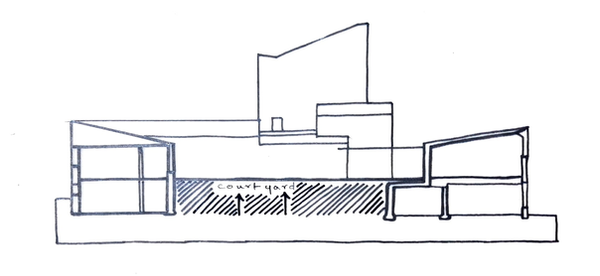
The court is raised above the natural site level by filling the central space with soil excavated for the foundation of the building.

PLAN AT GROUND LEVEL

PLAN AT COURTYARD LEVEL

NORTH - SOUTH SECTION

The building moves from the public street and shops at the bottom to the private council chamber at the top. The raised courtyard acts as the middle ground, creating a transition that leaves the noise of the town behind. By climbing the grass stairs from the public forest into the dark, shuttered interior, the experience shifts from open public access to a quiet, private seclusion.

Aalto wanted the building to appear as if it grew out of the hillside. By using earth and grass for the staircase, he blurred the line between nature and architecture
Aalto uses dark red brick to highlight local industries, accented by wood, copper, and stone flooring. The bricks are laid slightly off-angle so that as the sun shifts, shadows change and varied hues appear across the walls. Flemish bond brickwork with recessed mortar adds a sense of touch to the facade. The glass doors make the heavy brick building feel less restricted and more welcoming, creating a semi-public space where people can enter and move around easily. Through this transition zone, light percolates into the library and offices, reinforcing spatial continuity between outside and inside.

DETAIL - HANDRAIL OF THE STAIRCASE LEADING TO THE COUNCIL CHAMBER
Roof trusses support both roof and ceiling while creating airflow to manage winter condensation and summer heat. Butterfly trusses reduce the need for multiple intermediate supports. The sense of public accessibility is heightened by extensive glazing in the entrance lobby and corridors lining two sides of the courtyard. These open and accessible areas are intentionally designed to feel opposite to the council chamber, which is more enclosed, formal, and controlled in character.


Aalto’s phenomenological awareness in Säynätsalo Town Hall is reflected in the tactile, dark-to-bright passage leading to the council chamber. The dim, shuttered chamber expresses Aalto’s tectonics through light-structure interaction, while clerestory windows provide guidance.
Phenomenological intent is especially strong in the council chamber interior. Only in these secular buildings did Aalto avoid exposing the frame on curved surfaces or cutting thick partitions for light to shadow variety, sometimes employing a surface-plus-frame system instead.

In the council chamber, the ceiling is partly detached from the beams, with an even dimmer pair of wooden butterfly beams overhead. He deliberately detached the ceiling at the corners to create profound darkness.

The room is roughly cubic, with height nearly equal to wall length. It is naturally lit by a densely louvered west-facing window, while hanging lamps illuminate both the desks below and the wooden trusses above. While entering the chamber, one moves from transparent, accessible circulation areas into a heightened, concentrated civic volume.
While built in modernist techniques, Aalto drew inspiration from Renaissance and Medieval Italian civic architecture, with elements reminiscent of Venetian and Bergamo piazzas. After becoming legally protected, the building underwent major restoration beginning in 1995 and completed in 1998, marking Aalto’s hundredth birthday year. The town hall shows how it's architecture connects the public street to the private spaces through a clear physical journey.